If your pump clicks on and off every few seconds, your water pressure swings up and down, or water comes out of the air valve on top of your tank, you're most likely dealing with a waterlogged pressure tank. When a tank loses its air cushion, it can't store water under pressure, so the pump has to start almost every time someone opens a tap. That's short cycling, and it wears out pumps, motors and pressure switches far faster than normal operation.
The fix is often simple: reset the tank's air pre-charge, or replace the tank if the bladder has failed. But short cycling has other causes too, from leaking check valves to clogged pressure switches. Here's how to diagnose it on home well systems and building booster systems, what homeowners and building supers can safely check and when to call a pro.
How a Pressure Tank Is Supposed to Work
A pressure tank holds a cushion of compressed air alongside a reservoir of water. When the pump runs, it fills the tank and compresses the air. When you open a faucet, that air pushes stored water out, so the pump doesn't have to start for every glass of water. Only when pressure drops to the cut-in setting does the pump restart, and it runs until pressure reaches the cut-out setting.
There are three common types:
- Bladder and diaphragm tanks keep air and water separated by a flexible membrane. They're used on most residential well systems and many building booster packages.
- Hydropneumatic tanks without a membrane, common in older apartment and commercial buildings, let air and water touch. The water slowly absorbs the air, so these tanks need air added periodically, often by an air compressor or air volume control.
- Expansion tanks on closed heating systems absorb the expansion of water as it heats. They serve a different purpose but waterlog the same way.
Signs of a Waterlogged Tank or Short Cycling
- The pump starts and stops rapidly, sometimes every few seconds, while water is running.
- The pressure gauge drops and recovers in quick swings.
- Water pressure at faucets and showers pulses or surges.
- The pressure switch clicks constantly, or its contacts look pitted or burned.
- The tank sounds solid rather than hollow when you tap its upper half.
- Water comes out when you press the air valve stem.
- On a heating system, the relief valve drips or pressure climbs sharply as the system heats up.
What Causes Short Cycling
| Cause | What's happening | Typical fix |
|---|---|---|
| Low or no air pre-charge | Air has leaked out, leaving little room for stored water | Recharge to the correct pressure with the water side drained |
| Ruptured bladder or diaphragm | Water fills the whole tank and comes out of the air valve | Replace the tank, or the bladder on serviceable models |
| Undersized tank | Not enough stored water to give the pump the minimum run time its manufacturer specifies | Install a larger tank or add a second one |
| Leaking check valve | Pressure bleeds back toward the well or pump with no water in use | Replace the check valve |
| Clogged or failing pressure switch | The switch senses false pressure and turns the pump on and off erratically | Clean the sensing port or replace the switch |
| Plumbing leak | A running toilet or hidden leak keeps drawing pressure down | Find and fix the leak |
| Failed sensor or control settings (booster systems) | The controller can't hold a steady pressure | Replace the transducer or correct the settings |
What You Can Safely Check Yourself
Safety first: Tanks and piping are under pressure, and the line-side terminals of a pressure switch stay energized, often at 240 volts, even when the pump is off. Turn off the pump's breaker before working near the switch, and never loosen fittings on a pressurized tank.
1. The Tap Test
Tap the tank from top to bottom. A healthy bladder tank sounds hollow toward the top, where the air is, and duller lower down, where water is stored. If it sounds dull and solid all the way up, the tank is probably waterlogged.
2. The Air Valve Test
Briefly press the stem on the tire-style air valve, usually on top of the tank. A short hiss of air is normal. If water comes out, the bladder or diaphragm has failed and the tank needs to be replaced.
3. Check the Pre-Charge
On a residential well system, you can check the pre-charge with an ordinary tire gauge, but only with the water side of the tank empty:
- Turn off power to the pump at the breaker.
- Open a faucet near the tank and let it run until the flow stops and the system gauge reads zero.
- Check the air pressure at the tank's air valve.
- For most well systems, the pre-charge should be about 2 psi below the pump's cut-in pressure, for example 28 psi on a 30/50 pressure switch or 38 psi on a 40/60 switch.
- If it's low, add air with a small compressor or bicycle pump, then close the faucet and restore power.
If the tank won't hold air after recharging, it has a leak or a failed bladder and should be replaced. Constant-pressure systems with variable speed drives, building booster packages and heating expansion tanks use different pre-charge settings specified by the manufacturer or system designer, so don't apply the well-system rule to them.
4. Watch for Phantom Starts
If the pump kicks on when nobody is using water, something is letting pressure bleed off: a leaking toilet flapper, a dripping fixture, a hidden leak or a check valve that no longer seals. Close all fixtures and watch the pressure gauge. A steady drop tells you the problem isn't the tank.
Pressure Tanks in Apartment and Commercial Buildings
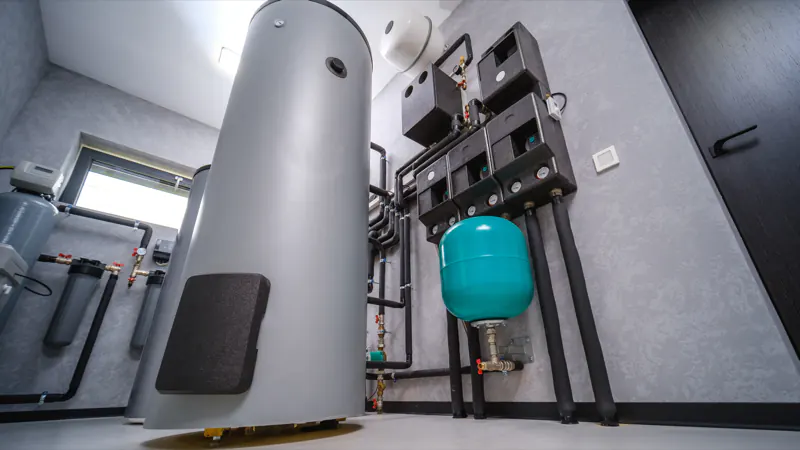
In multi-family and commercial properties, the tank is part of a larger water booster pump system. A waterlogged tank causes the same short cycling on a larger scale, with costlier equipment at stake. Older hydropneumatic systems also depend on an air compressor and level controls; when the compressor fails or the sight glass shows the tank nearly full of water, the pumps start cycling hard. If you manage a building, compare what you're seeing with our list of signs your water booster pump needs repair.
These tanks are large, heavy and pressurized, usually with three-phase controls nearby. Draining, recharging, re-piping or replacing them is work for a qualified technician.
Expansion Tanks on Heating Systems
On a closed hydronic heating system, the expansion tank gives heated water somewhere to go. When its diaphragm fails or it loses its air charge, system pressure spikes as the boiler heats, and the relief valve may start dripping or discharging. The pre-charge is normally set to match the system's cold fill pressure. Waterlogged expansion tanks often turn up alongside the issues in our guide to common HVAC circulator pump problems.
Repair or Replace?
A tank that has simply lost air can often be recharged and put back in service. A tank with water at the air valve, external rust or leaking seams usually needs replacing, although some larger commercial tanks have replaceable bladders. If a tank keeps waterlogging, it may be undersized for the pump, which a technician can check against the pump's flow and pressure settings. If short cycling has gone on for weeks, have the motor and pressure switch checked too.
When to Call a Professional
- Water comes out of the air valve, or the tank is leaking or rusting.
- Recharging the tank doesn't stop the short cycling.
- The pressure switch contacts are burned or the switch needs adjusting.
- The pump runs with no water in use, or you suspect a failed check valve in the well.
- You manage a building with a booster package, hydropneumatic tank or tank air compressor.
- The heating system's relief valve is discharging.
No water, or a pump cycling nonstop? LA New York Pump offers 24/7 emergency service. Call (631) 565-9577.
Get Your Tank Back in Balance
We service pressure, expansion and hydropneumatic tanks, from homes on private wells, still common in parts of Suffolk County and northern Westchester, to booster systems in apartment buildings across New York City and Nassau County. Learn more about our pressure tank services, or call LA New York Pump at (631) 565-9577 to schedule an inspection.
Frequently asked questions
What should my well pressure tank pre-charge be?
On most residential well systems, the air pre-charge should be about 2 psi below the pump's cut-in pressure, such as 28 psi for a 30/50 switch or 38 psi for a 40/60 switch. Check it only with the pump off and the water side of the tank drained. Booster systems and heating expansion tanks use different settings.
Can a waterlogged pressure tank be fixed?
If the tank has simply lost air, it can usually be drained and recharged to the correct pre-charge. If water comes out of the air valve, the bladder or diaphragm has failed, and the tank normally needs to be replaced, although some larger commercial tanks have replaceable bladders.
Is short cycling bad for my pump?
Yes. Each start sends a surge of current through the motor and wears the pressure switch or starter contacts. A pump that starts far more often than it was designed to can overheat and fail early, so short cycling should be corrected promptly rather than ignored.
Why does water come out of my pressure tank air valve?
Water at the air valve means the rubber bladder or diaphragm inside the tank has ruptured, letting water into the air side. The tank can no longer hold its air cushion, which causes short cycling and pressure swings. In most cases the tank needs to be replaced.

We are a family-owned pump repair company serving NYC, Long Island and Westchester. Questions about your pumps? Call (631) 565-9577 any time.