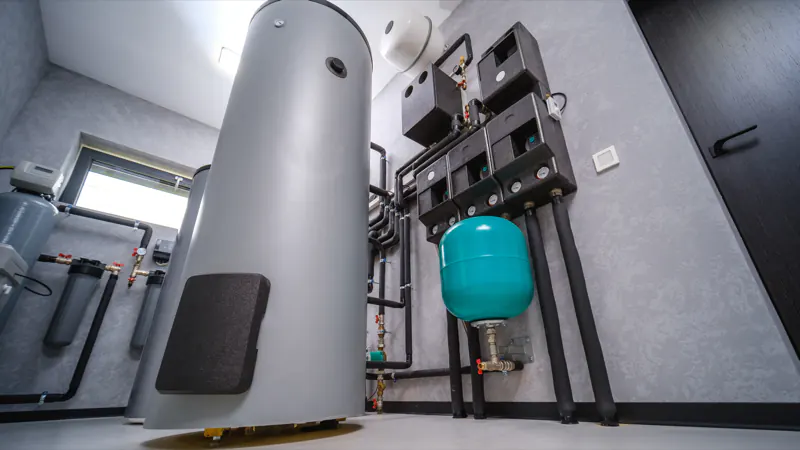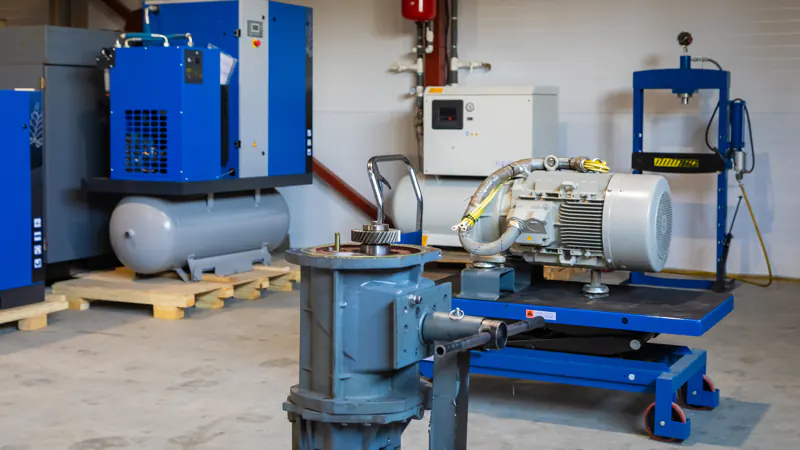
In many New York buildings, an air compressor in the basement quietly runs the heating and cooling controls, keeps a dry-pipe sprinkler system charged, or powers the tools and equipment of a shop. When it fails, thermostats and valves stop responding and residents call about apartments that are too hot or too cold, sprinkler supervisory alarms start sounding, or work grinds to a halt. LA New York Pump repairs and maintains air compressors for apartment buildings, co-ops and commercial buildings with pneumatic controls or dry-pipe sprinklers, and for light industrial facilities, across New York City, Long Island and Westchester.
Where Air Compressors Are Used in Buildings
Pneumatic HVAC controls
Many older office buildings, schools, hospitals and large apartment buildings in Manhattan and the other boroughs still use pneumatic controls: thermostats, valve actuators and damper motors that run on compressed air instead of electricity. A control air compressor, usually a tank-mounted duplex unit, stores air at a higher pressure, and a pressure-reducing station lowers it to the control main pressure, commonly around 20 psi. Pneumatic controls need clean, dry, oil-free air. Oil or water carried into the control lines can foul thermostats and actuators throughout the building, which is why these systems include a refrigerated air dryer and filters.
Dry-pipe and pre-action sprinkler systems
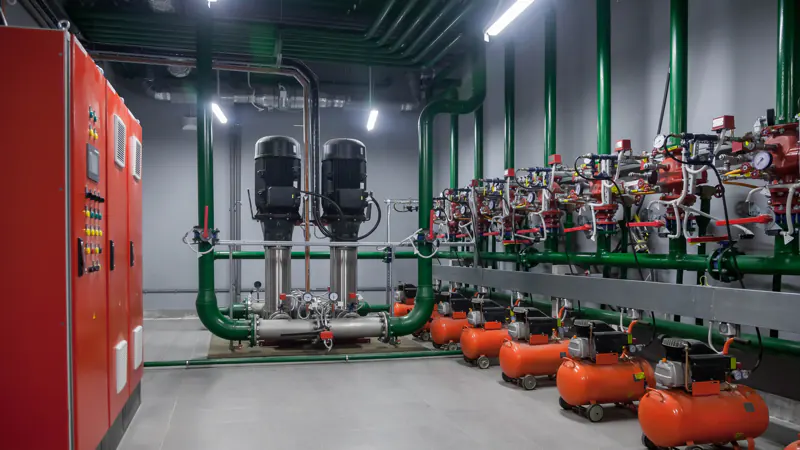
Sprinkler piping in unheated spaces such as parking garages, loading docks and attics can't be filled with water that might freeze. Instead it holds pressurized air, which keeps a dry-pipe valve closed until a sprinkler opens. An air compressor, often paired with an air maintenance device, keeps that pressure up. If the compressor fails or a leak outpaces it, air pressure drops and the valve can trip, filling the piping with water that then has to be drained before it freezes. The sprinkler system itself is inspected and tested under NFPA 25 and local fire code by qualified fire protection contractors; our work focuses on the compressor and its air supply.
Light industrial and shop air
Auto repair shops, dry cleaners, small manufacturers and maintenance shops depend on compressed air for tools, presses and process equipment. These compressors work harder and longer than control air units, and they need maintenance to match.
Reciprocating and Rotary Screw Compressors
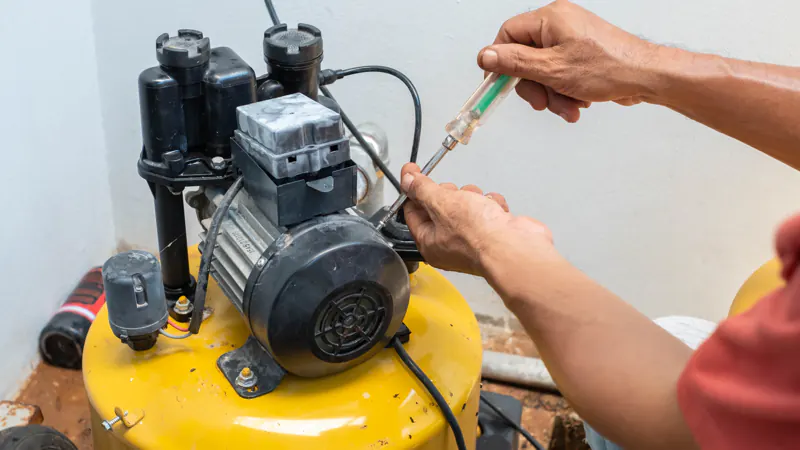
Reciprocating (piston) compressors are the most common type for control air and smaller shop systems. They can be single- or two-stage, oil-lubricated or oil-less, and they're designed to cycle on and off within a rated duty cycle. Most are belt-driven, with a pressure switch that starts and stops the motor and an unloader that bleeds off head pressure so the motor can restart without a load.
Rotary screw compressors use two meshing rotors to compress air continuously. They suit higher, steadier demand and are common in light industrial settings. Their maintenance centers on oil and oil filter changes, air/oil separator replacement, intake filters and keeping coolers clean.
Signs Your Air Compressor Needs Service
- The compressor runs constantly, or far more often than it used to
- It won't build up to its normal cut-out pressure
- Air keeps hissing from the unloader long after the compressor stops
- The safety relief valve pops open
- Oil or water shows up in the air lines, dryer or downstream equipment
- Knocking, squealing belts or heavy vibration
- The motor trips its overload or runs unusually hot
- Rust on the tank, or rusty water coming from the tank drain
Common Problems and Their Causes
| Problem | Common causes |
|---|---|
| Excessive run time | Leaks in piping, fittings or control devices; worn piston rings or valves; demand that has outgrown the unit |
| Continuous hiss after shutdown | A leaking tank check valve letting stored air back through the unloader, or a stuck unloader |
| Struggles or fails to restart | Failed unloader or leaking check valve leaving pressure on the pump head, a bad pressure switch or a starter problem |
| Water in the air lines | Tank not drained, failed automatic drain or a refrigerated dryer that isn't working |
| Oil in the air | Worn rings, an overfilled crankcase, the wrong oil, or a failed separator on a screw compressor |
| Overheating | Dirty cooling fins or intake filter, low oil, poor ventilation or a compressor running beyond its duty cycle |
Repair, Maintenance and Replacement
Repairs include replacing pressure switches, unloader and check valves, safety valves, belts and pulleys, intake filters, automatic drains, gaskets and valve plates; troubleshooting starters and motors; and finding and fixing air leaks. When the motor is the problem, our pump motor services cover testing and replacement, and starter and control issues fall under our control panel services.
Preventive maintenance includes checking and changing oil, replacing intake filters, checking belt tension and alignment, testing the safety valve, verifying pressure switch settings, confirming tank drains work, checking the dryer and filters on control air systems, measuring motor current and looking for leaks. On duplex control air units, we also confirm both compressors run and alternate.
Replacement makes sense when a compressor is worn out, undersized for today's demand, or sitting on a badly corroded tank. The receiver tank is a pressure vessel, and a rusted one should be replaced, not patched. We size replacement units to the actual demand and duty cycle.
Compressors We Work On
We service tank-mounted simplex and duplex reciprocating compressors, oil-lubricated and oil-less units, and rotary screw compressors, along with the refrigerated dryers, filters, automatic drains and pressure-reducing stations that go with them.
For Property Managers and Supers
- Have staff drain the tank on a regular schedule, or confirm the automatic drain works; water in the control lines causes problems all over the building
- On duplex control air units, both compressors should run and alternate, so one can carry the building while the other is repaired
- A dry-pipe compressor that runs constantly is worth a call before freezing weather, not after the system trips
- We explain the repair and replacement options, including when a corroded tank has to be replaced, so you can present them to the owner or board
See how we work with property managers and supers across New York City, Long Island and Westchester.
How Our Service Visits Work
We inspect the compressor, tank, dryer and controls while the unit runs, and watch how it loads and unloads. We discover the cause, which is often a leak or valve problem the compressor has been working around for months. Then we fix it and confirm the unit builds pressure, shuts off and restarts correctly. Cold weather is hard on compressors and the dry-pipe systems they serve, so see our tips on preparing equipment for a New York winter.
We serve apartment buildings, commercial properties and businesses throughout Manhattan, the Bronx, Long Island and Westchester.
Control air down or a compressor that won't keep up? Call LA New York Pump at (631) 565-9577. We're available 24/7 for emergencies across New York City, Long Island and Westchester.