A variable frequency drive (VFD) cuts pump energy costs by slowing the motor down whenever the building needs less than full flow. Because the power a centrifugal pump needs falls with the cube of its speed, a pump running at 80 percent speed needs only about half the power it uses at full speed, at least in theory. Most building pumps are sized for a peak demand that occurs only a small fraction of the time, so the opportunity is real.
How much a particular building saves depends on its load profile: how many hours the pump runs, how much of that time demand is below the design point, and how much of the pump's work is fixed lift rather than friction. This guide explains the affinity laws behind the savings, where drives pay off and where they do not, and what to watch for when you add one.
What a VFD actually does
A standard AC induction motor runs at a nearly fixed speed set by the line frequency, 60 Hz in the United States. To deliver less flow, a constant-speed system has to throttle a valve, open a bypass, rely on pressure-reducing valves, or cycle the pump on and off. Throttling works, but the energy burned across the valve is simply wasted.
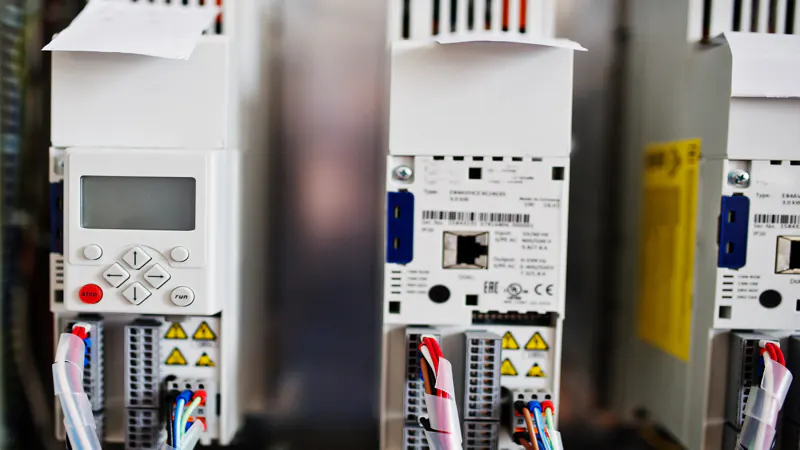
A VFD converts incoming AC power to DC and then back to AC at an adjustable frequency and voltage, which lets the motor run at whatever speed the system needs. A sensor tells the drive what is happening: usually a pressure transducer on a domestic water booster system, or a differential pressure sensor on a heating or chilled water loop. The drive's controller then adjusts speed continuously to hold a setpoint.
The pump affinity laws
For a given centrifugal pump and impeller, three relationships describe what happens when speed changes:
- Flow is proportional to speed: Q2/Q1 = N2/N1
- Head (pressure) is proportional to speed squared: H2/H1 = (N2/N1)2
- Power is proportional to speed cubed: P2/P1 = (N2/N1)3
The cube relationship is what makes drives attractive. Small reductions in speed produce large reductions in power:
| Speed | Flow | Head | Power (theoretical) |
|---|---|---|---|
| 100% | 100% | 100% | 100% |
| 90% | 90% | 81% | 73% |
| 80% | 80% | 64% | 51% |
| 70% | 70% | 49% | 34% |
| 60% | 60% | 36% | 22% |
| 50% | 50% | 25% | 13% |
Keep in mind: These are ideal figures for the pump alone. Real systems save less than the table suggests, for the reasons below, which is why any savings estimate should be based on your building's actual operating data.
Why real savings differ from the cube law
Static head
The affinity laws describe the pump; actual savings depend on the system it serves. In a closed heating or chilled water loop, almost all of the pump's head is friction, which drops quickly as flow drops, so the pump can slow down a lot and results come closer to the table. A domestic water booster system is different. It must always overcome the height of the building, no matter how little water is flowing, so the pump can never slow below the speed needed to hold pressure at the top floor. Savings there come mainly from eliminating throttling and pressure-reducing valve losses, and from lower friction at low flow, not from the full cube law.
Control setpoint and sensor location
On HVAC loops, a differential pressure sensor placed near the most remote coil lets the drive run at lower pressure during light loads than a sensor mounted across the pump. Setpoint reset strategies, where the setpoint drops as valves close, can capture more savings still. A poorly placed sensor or a setpoint set too high can erase much of the benefit.
Drive and motor losses
The drive itself has small losses, and motor efficiency falls at very light loads. These are usually minor compared with the savings from slowing down, but they matter in the calculation.
Hours at reduced load
A pump that runs at or near full load most of the time has little to gain. The best candidates run many hours a year with demand that swings widely.
Where VFDs pay off in buildings
- Domestic water booster systems in apartment and commercial buildings, where demand swings between morning peaks and overnight lows.
- Heating and chilled water loops with two-way control valves.
- Condenser water and cooling tower pumps, where the chiller manufacturer allows variable flow.
- Pumps that are throttled by a partly closed valve or feed pressure-reducing valves that drop a lot of pressure.
- Pumps that ended up oversized after building upgrades or fixture changes.
Drives make less sense on pumps that run only occasionally, such as sump and sewage ejector pumps, and on small circulators, where an ECM circulator with built-in speed control is the simpler choice. Fire pumps follow their own NFPA 20 rules; never add or change controls on a fire pump without proper engineering and approval from the authority having jurisdiction.
Benefits beyond the electric bill
- Soft starts and stops that reduce water hammer and mechanical stress.
- Lower inrush current when the motor starts.
- Steadier pressure for residents and tenants.
- Less wear on seals, bearings and couplings from fewer hard starts.
- Built-in diagnostics, fault history and connection to a building management system.
Pitfalls to avoid
- Motor compatibility: older motors were not designed for drive operation. Use inverter-duty motors, or add output filters where long cable runs between drive and motor are involved.
- Bearing currents: drives can induce shaft voltages that pit motor bearings; shaft grounding protects against this.
- Harmonics: drives can distort the building's electrical supply; line reactors or filters may be needed.
- Minimum speed: set it high enough to maintain minimum flow, motor cooling and required pressure, and program skip frequencies to avoid vibration resonance.
- Tuning: a poorly tuned control loop hunts, causing pressure swings and complaints.
- Redundancy: for critical pumps, plan a bypass or a standby pump so a drive fault does not leave the building without water or heat.
- Environment: drives need ventilation and protection from heat, dust and moisture in mechanical rooms.
How to evaluate a VFD for your building
- Estimate annual run hours and how demand varies by season and time of day.
- Identify the current control method: throttle valve, bypass, pressure-reducing valves or on-off cycling.
- Measure actual flow and pressure and compare them with the original design.
- Check the motor's age, efficiency and suitability for drive operation.
- Repair a worn pump before adding a drive; a drive will not fix worn impellers or failing seals.
- Ask your utility about current efficiency incentive programs before you buy.
For larger New York City buildings covered by Local Law 97's emissions limits, lower pump energy use is one of several measures that can help; your energy consultant can tell you how it fits your compliance plan. If your pumps are aging, our guide on pump repair vs. replacement can help you decide whether to retrofit a drive or replace the package. And if variable speed is on your list because tenants upstairs are complaining, read why upper floors lose water pressure.
VFD installation and service
We install, program and repair drives and pump control panels, and we service the pumps they run, from water booster systems to HVAC pumps. We work on packaged variable speed booster systems as well as standalone drives retrofitted to existing pumps, in buildings across the five boroughs, Long Island and Westchester County.
To find out whether a VFD makes sense for the pumps in your building, or across the buildings you manage, call LA New York Pump at (631) 565-9577. We will look at how your system actually runs and give you a straight answer, and we are available 24/7 if a pump or drive fails.
Frequently asked questions
How much energy can a VFD save on a pump?
It depends on the load profile: how many hours the pump runs, how often demand is below the design point, and how much of the pump's work is fixed lift versus friction. In theory, a pump at 80 percent speed needs about half the power it uses at full speed, but real savings are lower and should be estimated from your building's operating data.
Can a VFD be added to an existing pump?
Often, yes. The key checks are whether the motor is suitable for drive operation, whether the pump is in good condition, and how the system is controlled today. Older motors may need replacement with an inverter-duty motor or protective filters, and a worn pump should be repaired first, because a drive will not fix worn impellers or failing seals.
Do VFDs save as much on booster pumps as on HVAC pumps?
Usually not. A domestic water booster must always overcome the height of the building, so it cannot slow down as far as a closed heating or chilled water loop, where most of the head is friction. Booster savings come mainly from eliminating throttling and pressure-reducing valve losses and from lower friction during low demand.

We are a family-owned pump repair company serving NYC, Long Island and Westchester. Questions about your pumps? Call (631) 565-9577 any time.