Tanks don't move water, but they decide how hard your pumps have to work. A tank that has lost its air charge or ruptured its bladder makes a pump short cycle, overheats motors and can lift the relief valve on a heating system. In an apartment building, residents notice it as pressure swings in the shower and banging pipes long before the management office hears about a burned-out pump motor. LA New York Pump tests, recharges and replaces pressure tanks, expansion tanks and hydropneumatic tanks for apartment buildings, condos, co-ops, commercial properties and homes throughout New York City, Long Island and Westchester.
Types of Tanks We Service
Well and booster pressure tanks
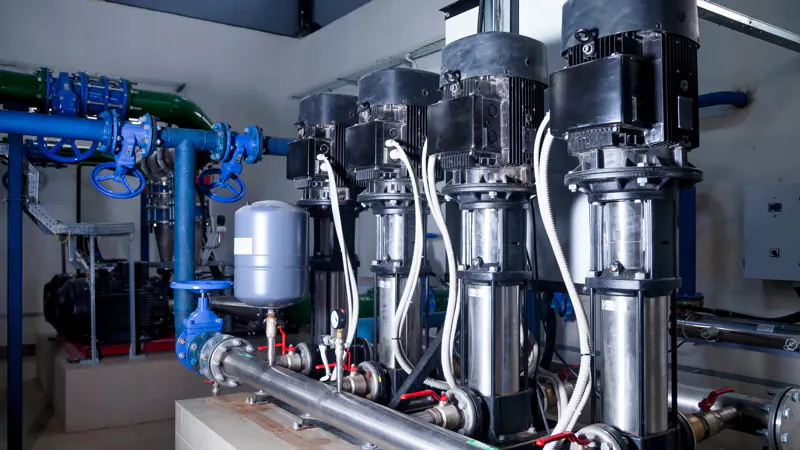
Homes on private wells, still common in parts of Suffolk County and northern Westchester, rely on a pressure tank to hold a reserve of water under pressure so the well pump doesn't start every time someone opens a faucet. In larger buildings, a hydropneumatic tank on a booster system does the same job: it covers small draws and minor leaks so the pumps can shut down at low or no flow.
Hydronic expansion tanks
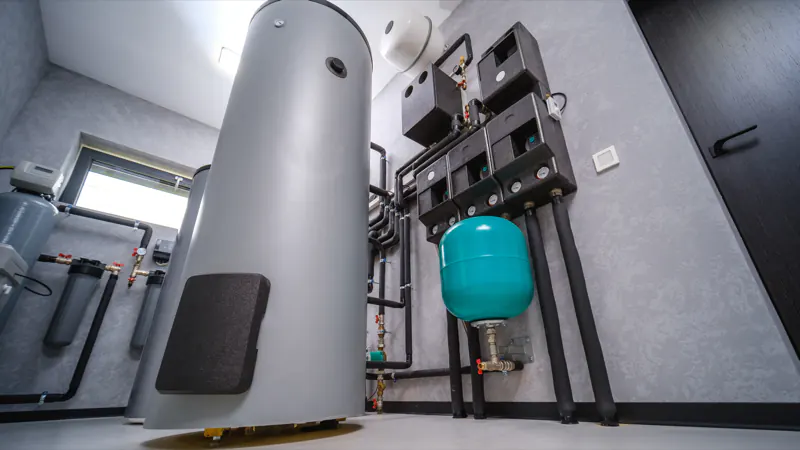
Water expands as a boiler heats it, and in a closed hot-water heating system, an expansion tank gives that extra volume somewhere to go. Modern tanks use a diaphragm or bladder to separate the water from a pre-charged air cushion. Older systems often use a plain steel compression tank, usually hung overhead near the boiler, where air and water are in direct contact.
Potable thermal expansion tanks
When a water service has a backflow preventer, check valve or pressure-reducing valve, water heated by the water heater can't push back into the main. A thermal expansion tank on the cold supply absorbs that expansion, so pressure doesn't climb every time the heater fires.
Large hydropneumatic and ASME tanks
Commercial systems may use large ASME-rated tanks, some with replaceable bladders, or older air-over-water tanks that depend on a compressor or charging system to maintain their air volume.
Signs of a Tank Problem
- The pump starts and stops every few seconds while water is running
- The pressure gauge swings rapidly between cut-in and cut-out
- Water spits out of the tank's air valve when you press the stem
- The tank sounds solid, not hollow, when you tap the top
- The boiler relief valve drips or discharges as the system heats up
- Water pressure in the house rises noticeably after the water heater runs
- Rust, sweating or leaks at the tank shell or fittings
For a closer look at these symptoms, see our article on pressure tank problems, waterlogging and short cycling.
Pre-Charge, Waterlogging and Bladder Failure
Every bladder or diaphragm tank has an air side charged to a set pressure through a valve like the one on a tire. That pre-charge has to match the system:
- On a well or booster tank, it's typically set about 2 psi below the pump's cut-in pressure, or to the value the system manufacturer specifies.
- On a hydronic expansion tank, it's set to match the system's cold fill pressure.
- On a potable thermal expansion tank, it's set to match the incoming static water pressure.
Air slowly escapes over time, and a tank that has lost its charge behaves as if it were far too small. The pre-charge must be checked with the tank isolated and its water side drained; a reading taken under system pressure is meaningless.
A tank is waterlogged when water has taken the place of the air cushion, either because the charge leaked away or because the bladder or diaphragm has ruptured. If water comes out of the air valve, the membrane has failed. On most residential and light-commercial tanks the membrane can't be replaced, so the tank must be. Plain steel compression tanks are different: air gradually dissolves into the system water, so these tanks periodically need to be drained and recharged, and frequent waterlogging points to a problem with the air control fittings or a leak.
Our Tank Services
Testing and repair. We isolate and drain the tank, check and adjust the pre-charge, test for a failed membrane, inspect fittings and isolation valves, and make sure the pressure switch or controller settings match the tank. Short cycling often involves both the tank and the controls, so we check the pump controls at the same time.
Preventive maintenance. Tank pre-charge belongs on every routine pump maintenance checklist. On booster systems we check the hydropneumatic tank at each visit; on heating systems we check the expansion tank before the heating season. We also look for corrosion and confirm that relief valves aren't discharging.
Sizing and replacement. A tank that's too small causes short cycling even when it's working perfectly. Correct sizing for a heating system depends on water volume, operating temperature, fill pressure and the relief valve setting; for a well or booster system, on the pump's flow rate, the pressure range and the motor's minimum run time. When we replace a tank, we size it to the system rather than copying the old one, mount and support it properly, and set the pre-charge before it goes into service.
Common Problems We Fix
| Symptom | Likely tank-related cause |
|---|---|
| Well or booster pump short cycling | Lost pre-charge, ruptured bladder or an undersized tank |
| Boiler relief valve discharging | Waterlogged or undersized expansion tank, or a pre-charge that doesn't match the fill pressure |
| Pressure spikes after the water heater runs | Missing or failed thermal expansion tank on a closed water system |
| Pressure swings and banging pipes | Waterlogged tank or pressure switch settings that don't match the tank |
| Rust or leaks at the tank | Corrosion of the shell or connections; the tank should be replaced |
For Property Managers and Supers
- Short-cycling pumps and dripping relief valves are often a tank problem, and catching them early protects far more expensive pumps and motors
- On a booster system, the hydropneumatic tank can often be recharged or replaced with the booster still in service, if the tank has its own isolation valve
- We include tank checks in booster and heating system maintenance so they aren't overlooked
- We explain whether a tank can be recharged or needs replacing, so you can approve the work or present it to the owner or board
See how we work with property managers and building portfolios across New York City, Long Island and Westchester.
How a Tank Service Visit Works
We inspect the tank, pump and controls while watching how the system cycles. We discover whether the problem is the charge, the membrane, the tank size or something else entirely, and explain what we found. Then we fix it by recharging, replacing or resizing the tank, and we watch several pump cycles to confirm the short cycling is gone.
We serve homes and buildings across Suffolk County, Westchester County, Nassau and the five boroughs. Tanks are a core part of our water booster pump and HVAC pump work, so we often handle them in the same visit.
Pump short cycling or a relief valve that won't stop dripping? Call LA New York Pump at (631) 565-9577. We're available 24/7 for emergencies across New York City, Long Island and Westchester.